TL;DR
- Creating an online course can be done within a budget of $3,000 or can exceed $30,000. Scope, media formats, SME involvement, and, of course, the features of the platform on which the course will be hosted all play a big role in the cost of online course development. So, how much does it cost to create an online course?
- Creating quality content costs money, and the largest items of expenditure in your budget will be video production, instructional design hours, custom development, and LMS integrations.
- A course in the form of simple slides and voice-over can launch in 4–6 weeks. Developing an enterprise-level training course will take at least 8–16+ weeks.
- Marketplace platforms limit branding. A custom LMS increases the initial investment, but ROI can be a win.
- To avoid overruns, make changes to the training content at the appropriate stage, not after development has already begun.
Course Development Cost by Component
Back in 2010, the Chapman Alliance published one of the most-cited benchmarks in e-learning: about $10,000 for one finished hour of interactive e-learning. Since then, 15 full years have passed, and a lot has changed for everyone who thinks about the average price for online courses.
Today, course creators have access to templates and authoring tools that speed up development and lower the cost of basic builds.
On the other end of the scale are costs related to stakeholder reviews, data and security requirements, accessibility, and platform integrations, which collectively add a few zeros to the final check.
That’s why we created and update this material every year to give you the real answer to how much does it cost to create an online course. Let’s get down to the details.
Time vs. Money Tradeoff
- Building the course yourself saves money but costs serious time.
- Outsourcing to a vendor like Raccoon Gang saves time and keeps quality high.
- Expect a higher price tag when you delegate production to pros.
Focus on Value
- Don’t start with “How much does it cost to build an online course?” Start with value.
- Define what learners save: time, errors, rework, and confusion.
- For employee training, tie value to revenue, performance, or risk reduction.
Learner’s Participation Type
- Passive content costs less and ships faster.
- Interactivity (simulations, branching) increases design and dev time.
- Hands-on skill training usually costs the most because it needs custom builds.
The Cost Variables
- Cost depends on length, complexity, format, topic, and content quality.
- Existing materials and in-house work reduce spend.
- Labor drives most of the budget; tools and equipment come after.
- If you build it yourself, you mostly “pay” with your time.
In practice, the cost per finished hour reflects your production model: template-based builds stay predictable, while high-interactivity or integration-heavy courses push you into a custom development budget.
An Overall Cost to Develop an Online Course
To make a long story short, let’s look at the overall cost of creating a training program. The numbers are based on information as of February 2026 about developing an online course from scratch.
As mentioned above, human efforts are the main expenses. Creating instructional content is almost impossible without a team of specialists who take on specific tasks.
The Hidden Costs of eLearning: The Human Factor
- SME or Subject Matter Expert is a specialist in the field in which your course will provide training material. They are engaged in research, text writing, lecture notes, and much more. Instructional design services are essential to ensuring that the course is pedagogically sound and learner-centered, making the training more effective.
- The instructional design team includes graphic designers, camera operators, video editors, and others.
- Project Manager is a course owner who oversees all aspects of course development and overall progress.
- Technical staff specialists are people responsible for the technical part of course creation (e.g., QA engineers, DevOps specialists, content managers, and others).
The professionals’ salaries will be the main component of the eLearning development costs. All subsequent information is collected from open recruitment sites (Upwork, SalaryExpert.com, Indeed.com). RacoonGang experts combined the data with our own experience in tailoring custom online learning solutions and created the numbers in the following charts.
| Team roles | Involvement stages | Time, hrs | Rate,$ | Final paycheck,$ |
| Course owner | All | Individual | Individual | Individual |
| SME | Design | Individual | Individual | Individual |
| PM | All | 40–55 | 40–180 | 1,600–9,900 |
| Instructional designer | Design, development | 50–79 | 25–150 | 1,250–11,850 |
| Marketer | Analysis | 30–40 | 15–150 | 450–6,000 |
| Lecturer | Design, development | 53–84 | 25–150 | 1,325–12,600 |
| Psycholinguist | Design, development | 20–35 | 40–220 | 800–7,700 |
| Graphic designer | Design, development | 59–86 | 10–120 | 590–10,320 |
| Director | Development | 3–5 | 40–250 | 120–1,250 |
| Video operator | Development | 3–5 | 20–120 | 60–600 |
| Video Editor | Development | 51–110 | 15–120 | 765–13,200 |
| Content manager | Implementation | 32–43 | 20–100 | 640–4,300 |
| Overall cost,$ | 7,600–77,720 | |||
In the chart below, you can see how numbers evolved during 2021-2026. This is the precise answer to the question of ‘How much does it cost to create a training program?’
| Year | 1 hour of eLearning content costs $ |
| 2026 | 7,600–77,720 (42,660 on average) |
| 2025 | 6,740–33,360 (20,050 on average) |
| 2024 | 7,520–31,965 (19,743 on average) |
| 2023 | 8,425–34,525 (21,475 on average) |
| 2022 | 8,542–36,320 (22,431 on average) |
| 2021 | 8,150–36,205 (22,178 on average) |
In the following sections, we’ll present a detailed analysis of how much does it cost to create a curriculum and a breakdown of participants’ roles in creating the course.
How Much Does it Cost to Develop an Online Course? 5 Key Steps to Evaluate
- Analysis and Its Cost
- Design Cost
- Development Price
- Implementation Price
- Maintenance Cost
Before developing an online course, it’s crucial to understand each stage and its associated costs. From initial analysis to implementation and maintenance as a consequence, each phase plays an important role in creating an engaging online learning experience. We will review the final expense estimate for each participant in the cost to develop a training course.
Stage #1. Analysis and Its Cost
How to develop an online course and make it sell? You hardly want your course to go unnoticed and be a dead weight. That is why it is essential to conduct an analysis. It will help clarify the feasibility of creating a course from an economic and social perspective.
The analysis stage includes researching the following aspects:
- Target audience
- Competition in the selected niche
- Possible and preferred ways of promotion
How much does it cost to create a training program, specifically the analysis stage?
| Team roles | Involvement stages | Time, hrs | Hourly rate, $ | Overall check, $ |
| Course owner | All | Individual | Individual | Individual |
| Marketing specialists | Analysis | 30–40 | 15–150 | 450–6,000 |
Once the analysis stage is set and done, it’s time to proceed to the design sequence.
Stage #2. Design Cost
The design phase in eLearning course development constitutes a significant portion of the overall cost. This includes creating the syllabus and topics and defining the course’s overall design and style. The cost varies depending on the complexity of the content and the visual elements incorporated into the course.
| Phase name | Specialists involved | Time, hrs | Upwork rates,$ | Contractors’ rates,$ | Experts’ rates,$ | Overall check,$ |
| Consultations with SME | SME | 10–15 | Individual | Individual | Individual | Individual |
| Psycholinguist | 10–15 | 30–150 | 40–220 | 220+ | 400–3,300 | |
| Lecturer | 10–15 | 20–75 | 25–150 | 150+ | 250–2,250 | |
| PM | 10–15 | 19–150 | 40–180 | 180+ | 400–2,700 | |
| Instructional designer | 10–15 | 20–75 | 25–150 | 150+ | 200–2,250 | |
| Designing visual content | Lecturer | 24–36 | 20–75 | 25–150 | 150+ | 600–5,400 |
| Instructional designer | 24–36 | 20–75 | 25–150 | 150+ | 600–5,400 | |
| Graphic designer | 24–36 | 15–150 | 10–120 | 120+ | 240–4,320 | |
| Designing practical tasks | Lecturer | 6–8 | 20–75 | 25–150 | 150+ | 150–1,200 |
| Instructional designer | 6–8 | 20–75 | 25–150 | 150+ | 150–1,200 |
Note: How to develop an online course and save some resources? You must have well-organized “face-to-face training content” rich in various media materials, visual content, and more. This content will help you quickly create a course storyboard for subsequent structuring, addition, alteration, and other integral operations of online course development.
Stage #3. Development Price
Development pricing online courses include course and lesson development. They also include content creation. And they include the necessary online course equipment. These expenses are crucial for creating high-quality and engaging online learning experiences. Proper budgeting and resource allocation for online course development costs are essential for the success of the educational program.
How much will that cost you?
| Phase name | Specialists involved | Time, hrs | Upwork rates,$ | Contractors’ rates,$ | Experts’ rates,$ | Overall check,$ |
| Writing notes | Lecturer | 10–20 | 20–75 | 25–150 | 150+ | 250–3,000 |
| Instructional designer | 10–20 | 20–75 | 25–150 | 150+ | 250–3,000 | |
| Psycholinguist | 10–20 | 30–150 | 40–220 | 220+ | 400–4,400 | |
| Video guideline design | Graphic designer | 15–20 | 15–150 | 10–120 | 120+ | 150–2,400 |
| Video Editor | 15-20 | 10–150 | 15–120 | 120+ | 225–2,400 | |
| Shooting videos | Lecturer | 3–5 | 20–75 | 25–150 | 150+ | 75–750 |
| Video operator | 3–5 | 15–60 | 20–120 | 120+ | 60–600 | |
| Director | 3–5 | 30–120 | 40–250 | 250+ | 120–1,250 | |
| Intro design | Graphic designer | 20–30 | 15–150 | 10–120 | 120+ | 200–3,600 |
| Video Editor | 20–30 | 10–150 | 15–120 | 120+ | 300–3,600 | |
| Editing videos | Video Editor | 16–20 | 10–150 | 15–120 | 120+ | 240–2,400 |
Stage #4. Implementation Price
So, all the training material is ready, and now is the time to add it to your chosen LMS. You can either create an online course platform on your own or choose an existing one.
However, this is not just a process of “pouring” content into the system. It is necessary to fully transform it into a ready-made course using the LMS tools. In addition, proofreading and error checking are critical to ensuring the maximum quality of the finished course.
| Phase name | Specialists involved | Time, hrs | Upwork rates,$ | Contractors’ rates,$ | Experts’ rates,$ | Overall check,$ |
| Course upload | Content manager | 2–3 | 25–80 | 20–100 | 100+ | 40–300 |
| Content manager | 30–40 | 25–80 | 20–100 | 100+ | 600–4,000 | |
| QA | PM | 30–40 | 19–150 | 40–180 | 180+ | 1,200–7,200 |
| Course owner | 30–40 | Individual | Individual | Individual | Individual | |
| Course creation monitoring | Course owner | 2–3 (daily) | Individual | Individual | Individual | Individual |
| Project management | PM | 2–3 (daily) | 19–150 | 40–180 | 180+ | 80–540 |
Also, the LMS setup is included in the final check.
| Team member | Hours | Hourly rate, $ | Overall check, $ |
| DevOps Engineer | 50–80 | 25–160 | 1,250–12,800 |
| Quality Assurance Specialist | 15–50 | 15–110 | 225–5,500 |
Note: All of the above roles can be combined to a certain degree in one specialist, for example, a video operator and a video editor in one person. The development stages can also be combined. These two facts can reduce the cost of development stages by 30%.
Stage #5. Maintenance Cost
Many teams forget this step. Please, don’t follow them.
After launch, you’ll need updates, bug fixes, analytics reviews, content improvements, localization, and possibly version upgrades.
Cost of Creating an Online Course on Open edX (and SaaS Alternatives)
The Open edX platform is an open-source learning management system. This LMS allows you to create online courses on any scale. The platform is an example of suitable solutions for e-learning businesses, and is free to use.
However, some costs are associated with setting up and running an online course on Open edX.
- Setup and Configuration. Although the Open edX platform is free, setting it up requires technical knowledge. You may need to hire an Open edX developer or a team to do the initial setup and configuration. This includes installing the platform, setting up the servers, and configuring the software to meet your specific needs. The cost can vary depending on the complexity of the setup and the hourly rates of the developers.
- Curriculum Development Cost. Just like with any other platform, you will need to create the course content. This includes writing the course materials, creating multimedia content, designing quizzes and assessments, and more. The cost can vary depending on the length and complexity of the course and the rates of the professionals involved in the creation process. We covered this topic in detail in previous sections.
- Maintenance and Upgrades. The Open edX platform is regularly updated with new features and improvements. To keep your platform running smoothly and take advantage of these updates, you will need to maintain and upgrade your installation regularly. This may require the services of a developer or a team, which will add to the costs.
- Hosting. The Open edX platform needs to be hosted on a server. You can choose to host it on your servers or use a hosting service. The cost of Open edX deployment can vary depending on the size of your course, the number of students, and the hosting provider you choose.
The Benefits of Open edX: A Closer Look
- Open-Source. The platform itself provides an open-source solution for developing and delivering online courses.
- Scalability. Open edX allows the creation of large-scale online courses, making it suitable for organizations looking to reach a broad audience.
- Customization. The software can be tailored to meet specific needs, allowing for tailored course development and delivery.
- Regular Updates. The platform is regularly updated with new features and improvements, ensuring that users can benefit from the latest developments in online learning.

SaaS LMS for Online Courses
If you’re exploring alternatives to managing the costs and complexities associated with setting up and running an online course on the LMS like Open edX, consider Tanuki – the SaaS LMS for Online Courses by Raccoon Gang.
Tanuki presents an efficient and innovative LMS subscription service that takes advantage of the powerful Open edX platform. By choosing Tanuki, you can significantly simplify the process of creating, organizing, and delivering online courses.
This comprehensive SaaS solution streamlines the complexities associated with managing the costs of setting up and running an online course. With Tanuki, you can enjoy a hassle-free approach to online course management, ensuring a seamless experience for both instructors and learners.
Summary – Cost to Create an Online Course
Online course development is a multi-stage and complex process, and thoroughly knowing the price in advance is impossible. Too many variables in the final price tag equation affect eLearning development costs. To get an accurate estimate, you should contact the experts in online course creation and book a demo to learn all the details.
Remember, the most successful courses require constant revision and improvement to correspond to today’s realities. Considering the trends in eLearning, it’s clear that online course development is a worthwhile investment.
Whether you’re planning to create your first online course or looking to improve an existing one, we hope this article has provided you with valuable insights and guidance.
Partner with Experts Who’ve Been Developing Online Courses Since 2015
Hiring a reliable partner can save you time and money when you develop an online course. Raccoon Gang has created online courses since 2015 and provides full-cycle implementation for eLearning projects.
Working with a partner that has extensive delivery experience also reduces budget risk: you get tighter scoping up front, clearer estimates by component, and fewer late-stage reworks because the team builds in QA, stakeholder review cadence, and platform constraints from day one.
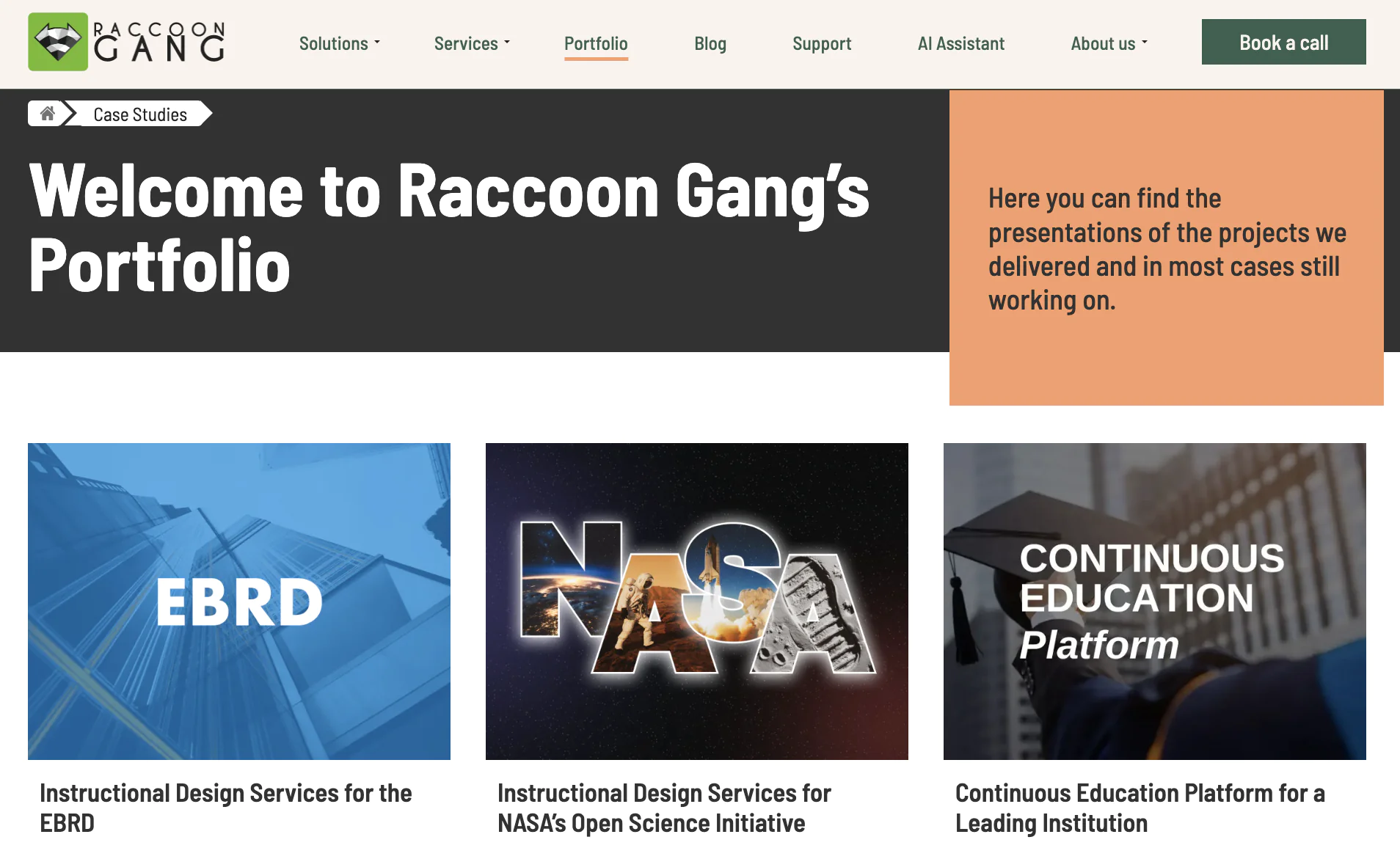
We deliver projects for organizations like NASA, EBRD, Salmon Trust, Harvard, and UCLA. These case studies demonstrate Raccoon Gang’s expertise in online course development and provide practical insights into the process and outcomes.
FAQ
How much does it cost to create an online course?
What does it take to build an online course?
How long does it take to develop 1 hour of eLearning?
What are the hidden costs of online course creation?
- Ongoing software subscriptions
- Content updates and maintenance
- Course hosting fees
- Licensing for copyrighted materials
- Paid marketing or ad campaigns
Planning for these expenses in advance helps prevent budget overruns.


- TL;DR Creating an online course can be done within a budget of $3,000 or can exceed $30,000. Scope, media formats, SME involvement, and, of course, the features of the platform on which the course will be hosted all play a big role in the cost of online course development. So, how much does it cost to create an online course? Creating quality content costs money, and the largest items of expenditure in your budget will be video production, instructional design hours, custom development, and LMS integrations. A course in the form of simple slides and voice-over can launch in 4–6 weeks. Developing an enterprise-level training course will take at least 8–16+ weeks. Marketplace platforms limit branding. A custom LMS increases the initial investment, but ROI can be a win. To avoid overruns, make changes to the training content at the appropriate stage, not after development has already begun. Course Development Cost by Component Back in 2010, the Chapman Alliance published one of the most-cited benchmarks in e-learning: about $10,000 for one finished hour of interactive e-learning. Since then, 15 full years have passed, and a lot has changed for everyone who thinks about the average price for online courses. Today, course creators have access to templates and authoring tools that speed up development and lower the cost of basic builds. On the other end of the scale are costs related to stakeholder reviews, data and security requirements, accessibility, and platform integrations, which collectively add a few zeros to the final check. That’s why we created and update this material every year to give you the real answer to how much does it cost to create an online course. Let’s get down to the details. Time vs. Money Tradeoff Building the course yourself saves money but costs serious time. Outsourcing to a vendor like Raccoon Gang saves time and keeps quality high. Expect a higher price tag when you delegate production to pros. Focus on Value Don’t start with “How much does it cost to build an online course?” Start with value. Define what learners save: time, errors, rework, and confusion. For employee training, tie value to revenue, performance, or risk reduction. Learner’s Participation Type Passive content costs less and ships faster. Interactivity (simulations, branching) increases design and dev time. Hands-on skill training usually costs the most because it needs custom builds. The Cost Variables Cost depends on length, complexity, format, topic, and content quality. Existing materials and in-house work reduce spend. Labor drives most of the budget; tools and equipment come after. If you build it yourself, you mostly “pay” with your time. In practice, the cost per finished hour reflects your production model: template-based builds stay predictable, while high-interactivity or integration-heavy courses push you into a custom development budget. An Overall Cost to Develop an Online Course To make a long story short, let’s look at the overall cost of creating a training program. The numbers are based on information as of February 2026 about developing an online course from scratch. As mentioned above, human efforts are the main expenses. Creating instructional content is almost impossible without a team of specialists who take on specific tasks. The Hidden Costs of eLearning: The Human Factor SME or Subject Matter Expert is a specialist in the field in which your course will provide training material. They are engaged in research, text writing, lecture notes, and much more. Instructional design services are essential to ensuring that the course is pedagogically sound and learner-centered, making the training more effective. The instructional design team includes graphic designers, camera operators, video editors, and others. Project Manager is a course owner who oversees all aspects of course development and overall progress. Technical staff specialists are people responsible for the technical part of course creation (e.g., QA engineers, DevOps specialists, content managers, and others). The professionals’ salaries will be the main component of the eLearning development costs. All subsequent information is collected from open recruitment sites (Upwork, SalaryExpert.com, Indeed.com). RacoonGang experts combined the data with our own experience in tailoring custom online learning solutions and created the numbers in the following charts. Team roles Involvement stages Time, hrs Rate,$ Final paycheck,$ Course owner All Individual Individual Individual SME Design Individual Individual Individual PM All 40–55 40–180 1,600–9,900 Instructional designer Design, development 50–79 25–150 1,250–11,850 Marketer Analysis 30–40 15–150 450–6,000 Lecturer Design, development 53–84 25–150 1,325–12,600 Psycholinguist Design, development 20–35 40–220 800–7,700 Graphic designer Design, development 59–86 10–120 590–10,320 Director Development 3–5 40–250 120–1,250 Video operator Development 3–5 20–120 60–600 Video Editor Development 51–110 15–120 765–13,200 Content manager Implementation 32–43 20–100 640–4,300 Overall cost,$ 7,600–77,720 In the chart below, you can see how numbers evolved during 2021-2026. This is the precise answer to the question of ‘How much does it cost to create a training program?’ Year 1 hour of eLearning content costs $ 2026 7,600–77,720 (42,660 on average) 2025 6,740–33,360 (20,050 on average) 2024 7,520–31,965 (19,743 on average) 2023 8,425–34,525 (21,475 on average) 2022 8,542–36,320 (22,431 on average) 2021 8,150–36,205 (22,178 on average) In the following sections, we’ll present a detailed analysis of how much does it cost to create a curriculum and a breakdown of participants’ roles in creating the course. How Much Does it Cost to Develop an Online Course? 5 Key Steps to Evaluate Analysis and Its Cost Design Cost Development Price Implementation Price Maintenance Cost Before developing an online course, it’s crucial to understand each stage and its associated costs. From initial analysis to implementation and maintenance as a consequence, each phase plays an important role in creating an engaging online learning experience. We will review the final expense estimate for each participant in the cost to develop a training course. Stage #1. Analysis and Its Cost How to develop an online course and make it sell? You hardly want your course to go unnoticed and be a dead weight. That is why it is essential to conduct an analysis. It will help clarify the feasibility of creating a course from an economic and social perspective. The analysis stage includes researching the following aspects: Target audience Competition in the selected niche Possible and preferred ways of promotion How much does it cost to create a training program, specifically the analysis stage? Team roles Involvement stages Time, hrs Hourly rate, $ Overall check, $ Course owner All Individual Individual Individual Marketing specialists Analysis 30–40 15–150 450–6,000 Once the analysis stage is set and done, it’s time to proceed to the design sequence. Stage #2. Design Cost The design phase in eLearning course development constitutes a significant portion of the overall cost. This includes creating the syllabus and topics and defining the course’s overall design and style. The cost varies depending on the complexity of the content and the visual elements incorporated into the course. Phase name Specialists involved Time, hrs Upwork rates,$ Contractors’ rates,$ Experts’ rates,$ Overall check,$ Consultations with SME SME 10–15 Individual Individual Individual Individual Psycholinguist 10–15 30–150 40–220 220+ 400–3,300 Lecturer 10–15 20–75 25–150 150+ 250–2,250 PM 10–15 19–150 40–180 180+ 400–2,700 Instructional designer 10–15 20–75 25–150 150+ 200–2,250 Designing visual content Lecturer 24–36 20–75 25–150 150+ 600–5,400 Instructional designer 24–36 20–75 25–150 150+ 600–5,400 Graphic designer 24–36 15–150 10–120 120+ 240–4,320 Designing practical tasks Lecturer 6–8 20–75 25–150 150+ 150–1,200 Instructional designer 6–8 20–75 25–150 150+ 150–1,200 Note: How to develop an online course and save some resources? You must have well-organized “face-to-face training content” rich in various media materials, visual content, and more. This content will help you quickly create a course storyboard for subsequent structuring, addition, alteration, and other integral operations of online course development.Stage #3. Development Price Development pricing online courses include course and lesson development. They also include content creation. And they include the necessary online course equipment. These expenses are crucial for creating high-quality and engaging online learning experiences. Proper budgeting and resource allocation for online course development costs are essential for the success of the educational program. How much will that cost you? Phase name Specialists involved Time, hrs Upwork rates,$ Contractors’ rates,$ Experts’ rates,$ Overall check,$ Writing notes Lecturer 10–20 20–75 25–150 150+ 250–3,000 Instructional designer 10–20 20–75 25–150 150+ 250–3,000 Psycholinguist 10–20 30–150 40–220 220+ 400–4,400 Video guideline design Graphic designer 15–20 15–150 10–120 120+ 150–2,400 Video Editor 15-20 10–150 15–120 120+ 225–2,400 Shooting videos Lecturer 3–5 20–75 25–150 150+ 75–750 Video operator 3–5 15–60 20–120 120+ 60–600 Director 3–5 30–120 40–250 250+ 120–1,250 Intro design Graphic designer 20–30 15–150 10–120 120+ 200–3,600 Video Editor 20–30 10–150 15–120 120+ 300–3,600 Editing videos Video Editor 16–20 10–150 15–120 120+ 240–2,400 Stage #4. Implementation Price So, all the training material is ready, and now is the time to add it to your chosen LMS. You can either create an online course platform on your own or choose an existing one. However, this is not just a process of “pouring” content into the system. It is necessary to fully transform it into a ready-made course using the LMS tools. In addition, proofreading and error checking are critical to ensuring the maximum quality of the finished course. Phase name Specialists involved Time, hrs Upwork rates,$ Contractors’ rates,$ Experts’ rates,$ Overall check,$ Course upload Content manager 2–3 25–80 20–100 100+ 40–300 Content manager 30–40 25–80 20–100 100+ 600–4,000 QA PM 30–40 19–150 40–180 180+ 1,200–7,200 Course owner 30–40 Individual Individual Individual Individual Course creation monitoring Course owner 2–3 (daily) Individual Individual Individual Individual Project management PM 2–3 (daily) 19–150 40–180 180+ 80–540 Also, the LMS setup is included in the final check. Team member Hours Hourly rate, $ Overall check, $ DevOps Engineer 50–80 25–160 1,250–12,800 Quality Assurance Specialist 15–50 15–110 225–5,500 Note: All of the above roles can be combined to a certain degree in one specialist, for example, a video operator and a video editor in one person. The development stages can also be combined. These two facts can reduce the cost of development stages by 30%. Stage #5. Maintenance Cost Many teams forget this step. Please, don’t follow them. After launch, you’ll need updates, bug fixes, analytics reviews, content improvements, localization, and possibly version upgrades. [cta-green t="Planning to Develop an Online Course?" d="We are ready to become your full-cycle eLearning project implementation partner."] Cost of Creating an Online Course on Open edX (and SaaS Alternatives) The Open edX platform is an open-source learning management system. This LMS allows you to create online courses on any scale. The platform is an example of suitable solutions for e-learning businesses, and is free to use. However, some costs are associated with setting up and running an online course on Open edX. Setup and Configuration. Although the Open edX platform is free, setting it up requires technical knowledge. You may need to hire an Open edX developer or a team to do the initial setup and configuration. This includes installing the platform, setting up the servers, and configuring the software to meet your specific needs. The cost can vary depending on the complexity of the setup and the hourly rates of the developers. Curriculum Development Cost. Just like with any other platform, you will need to create the course content. This includes writing the course materials, creating multimedia content, designing quizzes and assessments, and more. The cost can vary depending on the length and complexity of the course and the rates of the professionals involved in the creation process. We covered this topic in detail in previous sections. Maintenance and Upgrades. The Open edX platform is regularly updated with new features and improvements. To keep your platform running smoothly and take advantage of these updates, you will need to maintain and upgrade your installation regularly. This may require the services of a developer or a team, which will add to the costs. Hosting. The Open edX platform needs to be hosted on a server. You can choose to host it on your servers or use a hosting service. The cost of Open edX deployment can vary depending on the size of your course, the number of students, and the hosting provider you choose. The Benefits of Open edX: A Closer Look Open-Source. The platform itself provides an open-source solution for developing and delivering online courses. Scalability. Open edX allows the creation of large-scale online courses, making it suitable for organizations looking to reach a broad audience. Customization. The software can be tailored to meet specific needs, allowing for tailored course development and delivery. Regular Updates. The platform is regularly updated with new features and improvements, ensuring that users can benefit from the latest developments in online learning. SaaS LMS for Online CoursesIf you’re exploring alternatives to managing the costs and complexities associated with setting up and running an online course on the LMS like Open edX, consider Tanuki – the SaaS LMS for Online Courses by Raccoon Gang.Tanuki presents an efficient and innovative LMS subscription service that takes advantage of the powerful Open edX platform. By choosing Tanuki, you can significantly simplify the process of creating, organizing, and delivering online courses.This comprehensive SaaS solution streamlines the complexities associated with managing the costs of setting up and running an online course. With Tanuki, you can enjoy a hassle-free approach to online course management, ensuring a seamless experience for both instructors and learners.Summary – Cost to Create an Online Course Online course development is a multi-stage and complex process, and thoroughly knowing the price in advance is impossible. Too many variables in the final price tag equation affect eLearning development costs. To get an accurate estimate, you should contact the experts in online course creation and book a demo to learn all the details. Remember, the most successful courses require constant revision and improvement to correspond to today’s realities. Considering the trends in eLearning, it’s clear that online course development is a worthwhile investment. Whether you’re planning to create your first online course or looking to improve an existing one, we hope this article has provided you with valuable insights and guidance. Partner with Experts Who’ve Been Developing Online Courses Since 2015 Hiring a reliable partner can save you time and money when you develop an online course. Raccoon Gang has created online courses since 2015 and provides full-cycle implementation for eLearning projects. Working with a partner that has extensive delivery experience also reduces budget risk: you get tighter scoping up front, clearer estimates by component, and fewer late-stage reworks because the team builds in QA, stakeholder review cadence, and platform constraints from day one. We deliver projects for organizations like NASA, EBRD, Salmon Trust, Harvard, and UCLA. These case studies demonstrate Raccoon Gang’s expertise in online course development and provide practical insights into the process and outcomes. [cta-purple t="See How We Build Online Courses" b_url="https://raccoongang.com/case-studies/" b_name="Go to portfolio" d="Explore real eLearning courses delivered for universities, NGOs, and global organizations."] [faq title="FAQ"] [faq-item question="How much does it cost to create an online course?"] A simple course, without additional complex formats and with only (slides + voice-over), can start at $3,000. If we are talking about a professionally produced course with video, custom interactions, assessments, accessibility work, and LMS integrations, it typically costs $30,000+. [/faq-item] [faq-item question="What does it take to build an online course?"] To create a training program, you need meticulous planning, content creation, instructional design, technical setup, and rigorous quality assurance. From structuring course content to integrating multimedia elements and ensuring seamless user experience, each step contributes to the comprehensive development process. [/faq-item] [faq-item question="How long does it take to develop 1 hour of eLearning?"] The time required to develop one hour of e-learning content varies based on complexity, multimedia integration, and team proficiency. Typically ranging from 40 to 160 hours, the development process encompasses thorough planning, content creation, multimedia production, and quality testing to ensure optimal learning outcomes.[/faq-item] [faq-item question="What are the hidden costs of online course creation?"] Ongoing software subscriptions Content updates and maintenance Course hosting fees Licensing for copyrighted materials Paid marketing or ad campaigns Planning for these expenses in advance helps prevent budget overruns. [/faq-item] [faq-item question="How does the choice of eLearning authoring tools or platforms impact the cost estimate?"]The choice of e-learning authoring tools or platforms significantly impacts cost estimates due to licensing fees, learning curve considerations, feature variations, and integration demands. While some tools offer robust features with higher costs, others may provide more budget-friendly options, necessitating a careful evaluation of features versus expenses for optimal course development.[/faq-item] [/faq]
- Course Development Cost by Component
- An Overall Cost to Develop an Online Course
- How Much Does it Cost to Develop an Online Course? 5 Key Steps to Evaluate
- Cost of Creating an Online Course on Open edX (and SaaS Alternatives)
- Summary – Cost to Create an Online Course